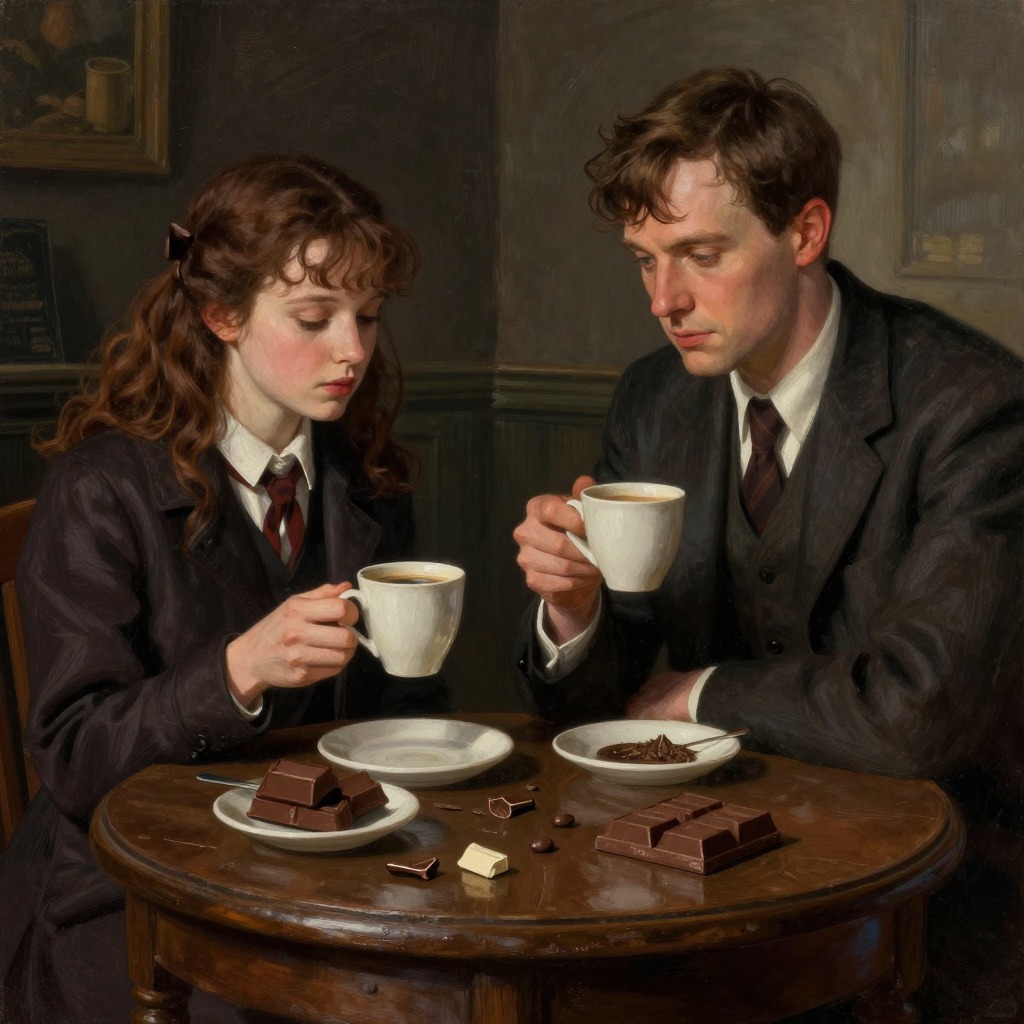
Victory Gin
Victory Gin is the synthetic spirit of Oceania, a colourless, oily liquid sold in plain white-labelled bottles and, in a society stripped of comforts, one of the few commodities that is cheap and plentiful. It is the drink that attends Winston Smith's whole trajectory: he first gulps it "like a dose of medicine" before opening the diary that constitutes his act of rebellion, and he is still drinking it at the Chestnut Tree Café when the last line of his story finds him loving Big Brother with "gin-scented tears" trickling down his nose. The drink is thus both a material fact of daily life and a register of the regime's power over the body and the emotions.
Material Reality and the First Dose
Winston's first encounter with the drink takes place in the tiny kitchen of Victory Mansions on the cold April day when he begins his diary. Having left the Ministry of Truth at lunchtime, he has sacrificed his canteen meal, and the kitchen offers nothing but a hunk of dark bread saved for tomorrow's breakfast; from the shelf he takes down a bottle of colourless liquid with a plain white label marked VICTORY GIN. It gives off "a sickly, oily smell, as of Chinese rice-spirit." He pours out nearly a teacupful, nerves himself for a shock, and gulps it down like a dose of medicine. The effect is immediate and violent: his face turns scarlet, the water runs out of his eyes, and the stuff tastes "like nitric acid," with the sensation of being hit on the back of the head with a rubber club. Only once the burning in his belly dies down does "the world began to look more cheerful." The same scene places the bottle beside the crumpled packet of VICTORY CIGARETTES whose tobacco falls out when held upright, pairing the spirit with the other flimsy, state-issued comforts of Oceania. Later the gin rises from his stomach in a belch; when it wears off it leaves "a deflated feeling."
Canteen Rituals and the Chronic Hangover
Victory Gin is the standard anaesthetic of the ministerial day. In the low-ceilinged canteen beneath the Ministry of Truth there is a small bar, "a mere hole in the wall," where gin can be bought at ten cents the large nip, and it is served in handleless china mugs. Winston drinks it in the same wincing way in company: he pauses to collect his nerve, gulps the oily-tasting stuff down, and then winks the tears out of his eyes before discovering he is hungry. The canteen's composite atmosphere is sour with "bad gin and bad coffee and metallic stew." At home, returning late after the alarming sight of Julia outside Mr Charrington's shop, his response is again a nearly teacupful of Victory Gin before he can sit down at the diary table; and when the drink wears off the world goes flat and deflated. It is a chemistry doled out in regular doses, an emotional prosthetic for a life without privacy, comfort or hope.
The Only Plentiful Commodity
The drink occupies a precise place in the Oceania economy. Among shortages of everything else, "nothing cheap and plentiful except synthetic gin" — a fact that makes it the default currency of consolation. It also marks class boundaries: the proles are not supposed to drink it at all, and their pubs serve beer in litres and half-litres, while the poor quarters offer a sexual outlet that "could even be purchased for a bottle of gin." The Party tolerates such degradation precisely because it is furtive and joyless, an outlet for instincts that cannot be altogether suppressed. Cheapness, availability and the absence of pleasure are all built into the drink; it anaesthetises without ever satisfying.
An Interlude of Renunciation
During the month of June, while the affair with Julia flourishes in the room above Mr Charrington's shop, Winston's relation to the bottle abruptly changes. He drops his habit of drinking gin at all hours, and seems to have lost the need for it; he grows fatter, his varicose ulcer subsides to a brown stain, his early-morning coughing fits stop. The process of life ceases to be intolerable, and he no longer feels the impulse to make faces at the telescreen or shout curses. The love affair supplies, naturally, what the gin had supplied chemically — a point the novel makes by clearing the drink out of his life at exactly the moment desire and hope enter it.
The Chestnut Tree, Rats and the Return of the Bottle
After the Ministry of Love, Victory Gin returns as the element in which Winston swims. At the Chestnut Tree Café, the waiters know his habits: an unbidden waiter fills his glass with Victory Gin, shaking into it a few drops from another bottle with a quill through the cork, "saccharine flavoured with cloves, the speciality of the café." It makes him shudder and retch; the cloves and saccharine cannot disguise the flat oily smell. More terribly, the smell of gin, which now dwells with him night and day, is "inextricably mixed up in his mind" with the smell of the rats — the creatures he could not even name to himself after the cage in Room 101. The drink becomes "his life, his death and his resurrection": it sinks him into stupor every night and revives him every morning, with the bottle and teacup placed beside his bed; through the midday hours he sits with glazed face, the bottle handy, and from fifteen to closing time he is a fixture of the café. He now has plenty of money and a sinecure, and the café's staff keep his glass filled and undercharge him; his features thicken, his nose and cheekbones turn coarsely red, and he belches through purple lips. At the story's end, as he gazes up at the enormous face of Big Brother, "Two gin-scented tears trickled down the sides of his nose" — the drink is present even in the moment of his final surrender.
A Brand Name Built on Contradiction
The name "Victory Gin" is itself a small exercise in doublethink. It promises triumph while delivering a drink that makes its consumers wince, retch and belch; in a world of chronic shortage, where even the Ministry of Plenty presides over want, it is the one abundant comfort, a synthetic substitute for everything that is missing. Like the slogans that declare "War is Peace" and "Freedom is Slavery," the brand attaches the language of celebration to an experience of deprivation. Winston's arc — from the medicinal first gulp that precedes his diary to the gin-scented tears of his last page — measures what the regime does with human longing: what cannot be supplied by love, hope or freedom is replaced, dose by dose, by the cheapest synthetic comfort Oceania can manufacture.